Pre-launch · open source
Small firms do not need reports. They need the work done.
BiznesIQ turns the enquiry into a quote, the quote into a scheduled job, and the finished job into an invoice that actually goes out. It drafts each step from what already exists in your inbox, and a person approves it. Open source, on infrastructure you control.
- Drafts, you approve
- Your server, your data
- Open source, no per-seat pricing
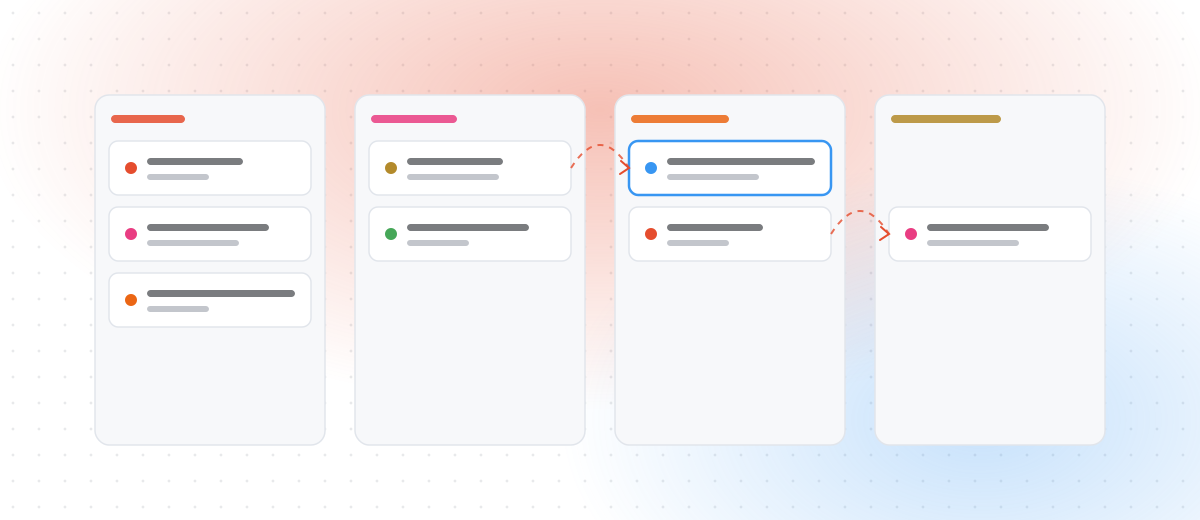
Three to fifteen people, and one of them is the software
The small-firm version of enterprise software problems, which is worse because there is nobody whose job it is to absorb them.
The owner is the integration layer
The enquiry is in email, the quote in a document, the job in a notebook, the invoice in accounting software. The person carrying data between them is the one who should be out selling, and there is no second person to hand it to.
The software only records
Every tool asks you to type in what already happened. That is data entry sold as a system, and it is why so many small firms end up with three subscriptions and a spreadsheet that is the real source of truth.
Priced for companies with seats
Per-user, per-month, from vendors whose smallest serious customer has two hundred employees. A five-person firm pays enterprise economics for a fraction of the value, and the data lives in the vendor's account either way.
Read, draft, done
The difference between a system that stores what you did and one that prepares what comes next.
- 01
It reads what already exists
The email thread, the message, the PDF the customer sent, the photo of a handwritten measurement. It extracts the job from what you already have, rather than asking you to re-enter it in a form.
- 02
It drafts the next step
The quote, the slot in the calendar, the materials list, the invoice, the polite second reminder. Prepared and waiting for you, which takes a decision from twenty minutes to twenty seconds.
- 03
You approve, and you own it
Nothing leaves without a person saying yes. It runs on your own server or your own cloud account, the data is in your database, and the source is public — so nothing about this arrangement depends on us continuing to like you.
The six things a service firm actually runs on
Not a suite. The parts of the week that decide whether a small firm makes money.
Quotes from a conversation
A drafted quote built from the enquiry thread, priced against what you charged for similar work before, ready to send in one read-through rather than one evening.
Jobs and scheduling
Scheduling against the constraint that actually binds a small firm — which person can be where, with what, and when — instead of a calendar that knows only about time.
Invoices that go out
The invoice raised when the job closes rather than when somebody remembers, and the follow-up sent on schedule. This alone is the difference between paid in three weeks and paid in three months.
Documents in, structure out
Supplier PDFs, customer emails, photos from site, scans. Read, filed against the right job, and searchable — because in most small firms the archive is an inbox with attachments.
Runs where you decide
Your own machine, your own hosting account, or a provider you choose. No obligation to keep a customer database inside somebody else's product to keep using it.
Open source, properly
Readable, forkable, and possible to hire somebody else to maintain. If we stop, the software does not, and that promise is only worth anything because the licence enforces it.
System of record, system of action
Most business software is a system of record: a well-organised account of what already happened, kept up to date by people typing. That model was built for companies with enough staff to have someone whose job is the typing. Small firms do not have that person, which is why their systems are always out of date and why the owner ends up being the integration between them.
- A record waits. It holds a form until somebody fills it in, and it is accurate exactly as often as somebody does.
- An action prepares. It produces the quote, the invoice, the reminder, and asks you to confirm rather than to compose.
- The unit of work is the job. Not a module, a licence tier, or a table. The thing you did for a customer, with everything about it in one place.
- Approval stays with a person. Every outgoing action is a draft. That is a deliberate design decision, not a first-version limitation.
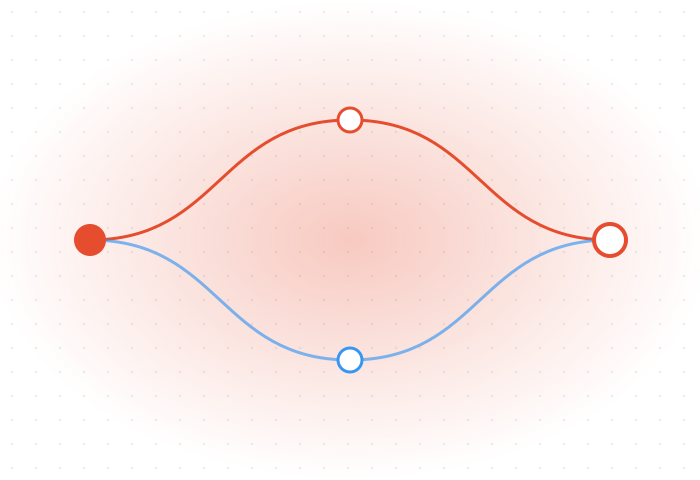
Why open source matters more at five people than at five hundred
Large companies negotiate. They have leverage, procurement, lawyers and the option of being a reference customer. A five-person firm has none of that, and takes whatever price rise, feature removal or shutdown arrives in an email. The smaller the business, the more a vendor's decision costs it — which is the opposite of how software is usually sold.
- No per-seat tax on growing. Hiring a sixth person should be a business decision, not a licensing one.
- The data is in your database. Exportable because it is yours, not because a feature request was granted.
- Somebody else can maintain it. The code is public, so we are not the only possible supplier — including when the supplier you want to fire is us.
- It outlives us. A small firm that built its operations on software cannot afford for that software to be somebody else's runway.
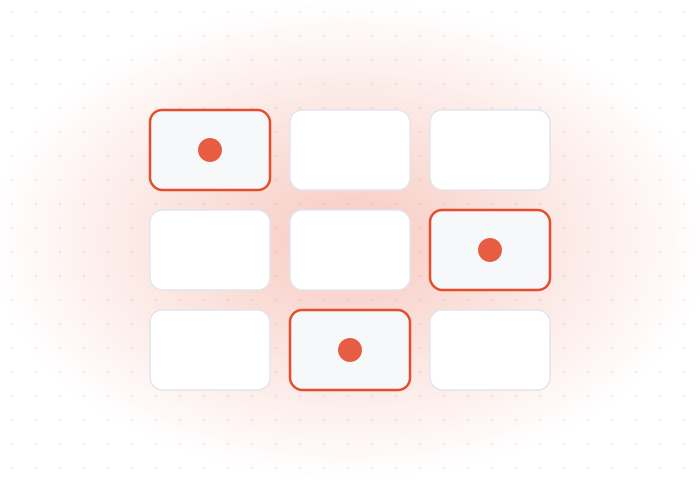
Nothing is running for anybody else yet
Business software that has not survived a real month of a real business should say so.
- Now
Running our own operations on it
Real quotes, real jobs, real invoices, in businesses we are responsible for. The fastest way to find out which parts of this are wrong.
- Next
The first few firms
A small number of service businesses, chosen for fit, set up with help and watched closely. Their complaints will decide the next year more than any plan would.
- Later
The regulated edges
Accounting handover and structured e-invoicing are where a system like this has to be exactly right rather than roughly right. They come after the core works, and they will be described honestly when they arrive.
Frequently asked questions
What is BiznesIQ in one sentence?
An open-source operating system for a small service business that drafts the next step — quote, schedule, invoice, follow-up — from what is already in your inbox, and runs on infrastructure you control.
What does system of action actually mean?
That the software prepares work rather than waiting to be told about it. A system of record asks you to enter the invoice. A system of action drafts the invoice when the job closes and asks whether to send it. The difference is roughly the difference between a filing cabinet and an assistant.
Do I need a server and someone technical?
For the self-hosted version, yes — a small machine or a hosting account and somebody comfortable with it. That is an honest requirement, not something to hide. A managed option is planned so that owning your data does not require running a server, and it will be priced so that leaving stays possible.
Does the AI send things to customers by itself?
No. Everything outbound is a draft that a person approves. That is the design, not a cautious first release, because a wrong quote or a wrong invoice costs a small firm more than the time it saved.
Does this replace my accountant?
No, and any software claiming to is worth avoiding. The goal is that your accountant receives complete, structured, correctly categorised data instead of a folder of PDFs in January.
What about e-invoicing and tax reporting?
Not built yet, and it will not be claimed before it is. Structured e-invoicing has to be exactly right, so it comes after the core is proven, with a clear statement of what is supported and what is not.
What will it cost?
The software is open source, so self-hosting costs you infrastructure and your own time. A managed option will be priced per business rather than per user, because charging a five-person firm to add a sixth person is the model we are arguing against.
Is it really open source?
That is the correct question to ask everyone who says it. The licence, the repository and what is genuinely covered by both will be published before the first release, because open source announced in a headline and contradicted in a licence file is now a common trick.
Tell us what your week actually looks like
The waitlist form goes live soon. Until then the blog explains what is being built and, more usefully, what is not.
No form yet, no data collected — just come back.